



How a Standing Desk Can Reduce Pain at Work
Mark had always been a dedicated and hardworking individual. As an IT professional, he spent most of his workday seated in front of a computer screen, troubleshooting technical issues and ensuring his company’s systems run smoothly. His dedication to his job was admirable, but it came at a significant cost—chronic back pain that seemed to have become a permanent companion in his life.
The back pain started as an occasional discomfort, something Mark attributed to long hours at his desk or perhaps a few restless nights of sleep. However, as time passed, it escalated into something far more insidious. The dull ache in his lower back had evolved into sharp, stabbing pains radiating down his legs, making every step challenging and task grueling. It was affecting not only his work but also his overall quality of life.
Frustrated and desperate for relief, Mark decided to seek professional help. He made an appointment with us at Ellis Physical Therapy, hoping we would provide the answers he desperately needed.

Our Patients Get Great Results
“Dr. Jason Bailey worked on me and knew exactly how to relieve my pain. I’ve had chronic muscle pain right around my shoulder blade for years and have never had great luck in relieving it. I’ve tried several solutions but only ever seen temporary results. Massaging feels good in the moment but the pain returns. When I saw Dr. Bailey, he took a look at my shoulder and knew exactly where the pain was. He could pinpoint it on the first try. I constantly ask my wife to massage it and she can never even find the painful spots consistently. I can’t believe Dr. Bailey was able to know right away what was causing the pain. He recommended dry needling. I was hesitant at first because it was new to me and I was in disbelief that it would do anything. He took the time to explain to me the benefits of dry needling, and how it will restart those muscle groups that are locked up and not receiving adequate blood flow. I conceded and he stuck me with a few needles. They weren’t painful in the least. Like not even a prick. I’ve hurt worse getting a haircut! He knew exactly where to stick the needles, and he’d even tell me as he’s doing it that I’ll feel this one more or that one less, etc. I don’t even know how he knew, but he was spot on. I’m a big fan of his and of the dry needling process. I highly recommend you pay him a visit and get yourself the pain relief your body needs!”
– J.M.

Meeting His Physical Therapist
Mark’s first visit was an eye-opener. His therapist conducted a comprehensive evaluation, assessing his posture, range of motion, muscle strength, and any underlying factors contributing to his pain. The therapist listened as Mark described his daily routine and work environment, particularly the long hours spent at his desk.
After the evaluation, his physical therapist explained the findings to Mark. It was evident that his prolonged sitting at work was a significant contributor to his back pain. His posture was less than ideal, and the constant strain on his lower back had led to muscle imbalances and irritation of the nerves in the area. His therapist assured Mark that he could significantly improve his condition with the right approach.
The Power of Ergonomics and Lifestyle Changes
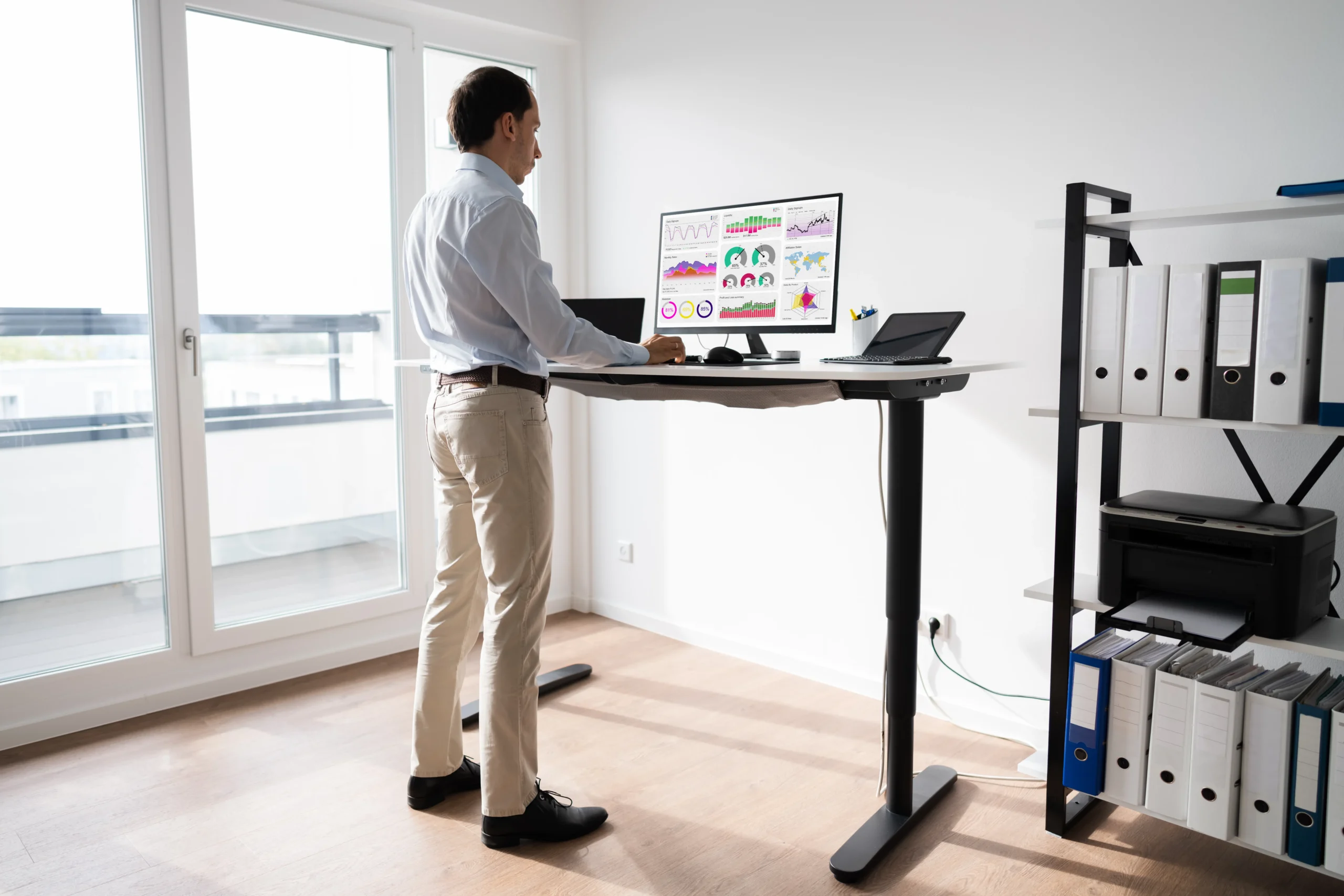
One of his physical therapist’s first recommendations was introducing ergonomic adjustments to Mark’s workspace. She suggested that Mark invest in a standing desk. The idea initially caught him off guard, but the therapist explained that alternating between sitting and standing throughout the workday could alleviate the strain on his back and promote better posture.
Mark decided to try it, and the impact was almost immediate. The standing desk allowed him to switch positions whenever he felt discomfort creeping in. He found that he could focus better on his work and that his back pain gradually started to recede.
But his therapist’s guidance continued. She also provided Mark with a list of ergonomic tips for his workspace. She advised him on how to adjust his chair, monitor height, and keyboard placement to ensure his work environment was as back-friendly as possible.
Beyond the office, the therapist emphasized the importance of maintaining an active lifestyle. She recommended specific exercises to strengthen his core and back muscles, explaining that a strong foundation would help support his spine and prevent further pain.
Life-Changing Results
Over the following weeks, Mark diligently followed his physical therapist’s recommendations. He embraced the standing desk and ergonomic adjustments, taking frequent breaks to stretch and move around. He incorporated the prescribed exercises into his daily routine, gradually building his strength and stability.
The results were life-changing. Mark’s back pain, which had once seemed debilitating, faded into the background. He found himself walking without discomfort and even rediscovered the joy of hiking in the nearby nature reserve, a hobby he had long abandoned.
At work, Mark’s productivity improved as his focus sharpened. He realized that investing in his well-being alleviated his pain and enhanced his professional life. The standing desk had become an invaluable tool, allowing him to switch between sitting and standing effortlessly and, in turn, preserving his back health.

Take Control of Your Back Pain Today
Today, Mark’s life has transformed. His experience serves as a reminder that taking proactive steps to address pain can lead to remarkable improvements in one’s quality of life. If you’re ready to embark on your own path to recovery and well-being, reach out to Ellis Physical Therapy today!
Exercise of the Month: Dead Bug
Lie down on your back with your arms by your sides, your knees bent to 90-degrees, and your feet on the floor. Raise one arm up straight and one knee up towards the ceiling at the same time. Your arm should stay straight and be pointing straight up at the top and your knee should be at 90-degrees and be pointing straight up at the top.
3 Sets, 10 Reps.

Recipe of the Month: Cinnamon Rolls

Ingredients:
DOUGH
- ¾ cup milk
- 2 ¼ teaspoons active dry yeast
- ¼ cup granulated sugar
- 4 tablespoons salted butter, melted and cooled
- 1 large egg plus 1 large egg yolk, at room temperature
- 3 cups bread flour, plus more as needed
- ¾ teaspoon kosher salt
- Extra-virgin olive oil, for greasing the bowl
FILLING
- 4 tablespoons salted butter, softened
- ⅔ cup packed dark brown sugar
- 1 ½ tablespoons ground cinnamon
CREAM CHEESE FROSTING
- 4 oz cream cheese, softened
- ¾ cup powdered sugar
- 3 tablespoons salted butter, softened
- ½ teaspoon vanilla extract
Instructions:
- Warm milk in a microwave-safe bowl for 45–60 seconds, until 115°F. Pour into a stand mixer bowl fitted with the paddle attachment and sprinkle yeast on top. Add sugar and let sit until foamy, about 5 minutes. Add melted butter, egg, and egg yolk; mix on medium speed until combined, about 30 seconds. Stir in flour and salt with a wooden spoon until a dough begins to form.
- Attach the dough hook and knead on medium speed until soft and slightly sticky, 8–10 minutes. Add up to 3 tablespoons more flour if needed. (Alternatively, knead by hand on a floured surface for 8–10 minutes.) Warm a clean dish towel in the dryer during this step. Lightly grease a large bowl with olive oil. Transfer dough to the bowl, cover with plastic wrap and the warm towel, and let rise until doubled, 1–1½ hours. Dough is ready when an indentation from a finger does not spring back immediately.
- Dust a surface with flour and roll dough into a 10×14-inch rectangle. Spread softened butter evenly, leaving a ¼-inch margin on one short edge. Mix brown sugar and cinnamon; sprinkle over butter and gently press into it. Roll tightly from the opposite short side, pinch to seal, and place seam-side down. Trim ½ inch off each end. Compact the roll slightly by pressing inward from both ends. Cut into nine 1-inch slices using dental floss or a serrated knife.
- Line a 9-inch round or square pan with parchment. Arrange rolls in the pan, cover with plastic wrap and towel, and let rise until doubled and touching, 45–60 minutes. Preheat oven to 350°F. Bake rolls for 20–25 minutes, until golden on the edges but soft in the center. Cool for 10 minutes.
- In a mixer with the whisk attachment, beat cream cheese, powdered sugar, butter, and vanilla on low for 30 seconds, then on medium-high until smooth and fluffy, 1–2 minutes. Spread over warm rolls. Cover pan tightly or place rolls in airtight containers. Refrigerate up to 5 days. Reheat individual rolls in the microwave in 15-second intervals until warm.
Unmasking the Mystery of Pain:
How Physical Therapy Finds the Source

Pain often conceals its true origins, leaving individuals confused and seeking answers. Two common examples of pain misleading people are shoulder blade pain and buttock pain. In both cases, the location of discomfort may mislead individuals into believing that the problem resides where it hurts the most, but our Ellis Physical Therapy experts can shed light on a different truth.
Shoulder Blade Pain = Neck Pain
Shoulder blade pain, frequently attributed to issues within the shoulder joint, can, in reality, stem from the neck. Research has shown how cervical spine conditions can often refer pain to the shoulder blade region. This example underscores the need for accurate diagnosis and the role of physical therapists in deciphering the puzzle of shoulder blade pain.
Butt Pain = Back Pain
Pain in the buttock region is often misinterpreted as pain from the buttock muscles. However, multiple studies emphasize that this discomfort can signify underlying problems in the lower back. Conditions such as lumbar disc herniation, sciatica, or lumbar spinal stenosis can provoke buttock pain due to nerve compression or irritation in the lower back.
Finding Clarity and Relief: Physical Therapy’s Role
Physical therapy emerges as a beacon of clarity in this maze of pain misinterpretation. Through our comprehensive assessment process, we can determine the source of your discomfort. We are experts at weeding through your symptoms to figure out your pain referral patterns and provide much-needed answers. Through tailored treatment plans, we address your symptoms and the root causes of pain. At Ellis Physical Therapy, we’ll empower you to take control of your pain and improve your quality of life!